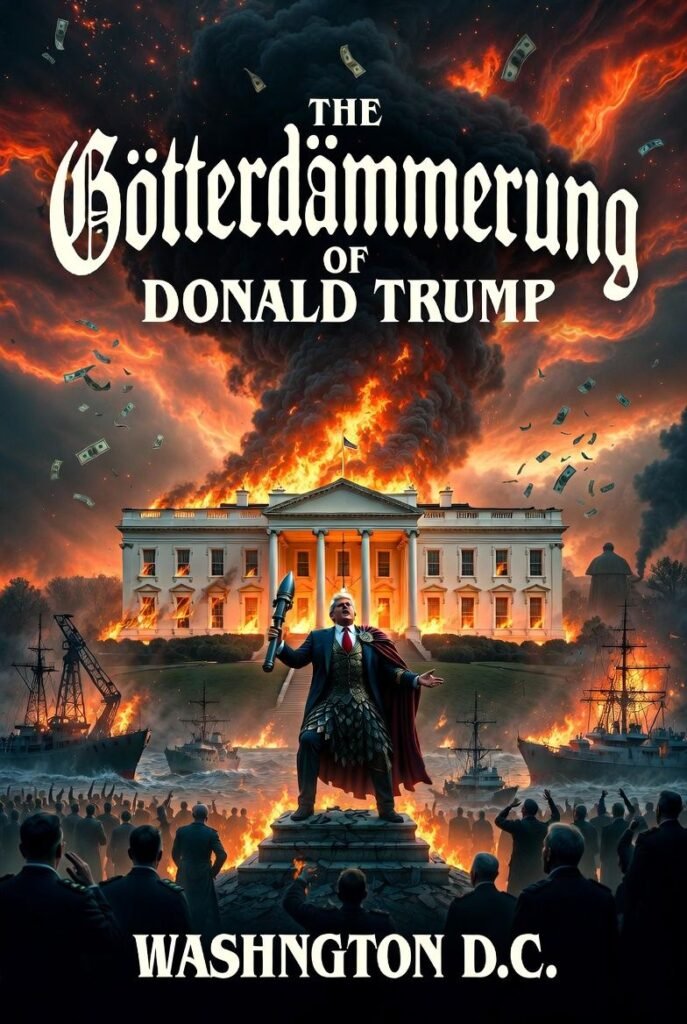
In the space of weeks, the second Trump presidency has entered a phase that bears an unsettling resemblance to the final act of Wagner’s Götterdämmerung: a once-dominant figure, surrounded by flames of his own making, watches the structures he claimed to command begin to collapse.
What began as a calculated show of strength against Iran has metastasised into a pattern of erratic decision-making that senior national-security professionals now describe, in private briefings and public retrospectives, as a direct threat to American and global stability.
The sequence is now a matter of public record. On 27 February 2026, President Trump authorised Operation Epic Fury — a joint US-Israeli campaign of missile, drone, and airstrikes against Iranian nuclear and military targets. Within days he declared the Iranian military “destroyed.” Yet the conflict did not end. Instead, after a fragile two-week ceasefire, the administration imposed a naval blockade of Iranian ports and the Strait of Hormuz beginning 13 April, threatening to “destroy” any Iranian warships that approached and warning that refusal to reopen the strait would lead to the obliteration of power plants, oil infrastructure, and, in one widely quoted Truth Social post, “an entire civilization.” Hours later the same president spoke of having consulted “the other side” and remaining open to talks. Markets, shipping insurers, and allied governments have been left to navigate the whiplash.
This is not the disciplined unpredictability sometimes praised by Trump’s supporters. It is a pattern of public contradiction that has eroded the credibility of American deterrence. Retired four-star officers and former CENTCOM commanders have noted that the president’s public rhetoric has repeatedly outrun both intelligence assessments and operational planning. The same intelligence community whose assessments Trump has openly dismissed — most recently on the pace and intent of Iran’s nuclear programme — had warned that a sustained blockade risked precisely the oil-price shock and regional spillover now materialising. Yet those assessments were characterised by the president as “wrong.”
The disregard extends beyond the intelligence agencies. The administration’s national-security strategy document has been criticised even by conservative analysts as incoherent, a mix of bombast and self-contradiction that offers no coherent theory of victory in the very theatre where American forces are now engaged. Military professionals who served under previous administrations, Republican and Democratic alike, describe a decision-making process that bypasses the rigorous inter-agency process designed to surface objections and second-order effects. The result is policy made in public bursts rather than through deliberate planning.
Compounding the strategic hazard is a deepening institutional rupture at home. In the midst of Holy Week, Pope Leo XIV — the first American-born pontiff — delivered measured but unambiguous criticism of the war, warning against any “delusion of omnipotence” and calling for the protection of civilians and the reopening of humanitarian channels. President Trump responded by labelling the Pope “weak on crime” and “terrible” on foreign policy, and by sharing (then deleting) an AI-generated image depicting himself in the robes and posture of Christ. In a Palm Sunday address he drew an explicit parallel between the crowds hailing Jesus as king and those now hailing him with the same title. The spectacle has alienated a broad spectrum of American Catholics — including many who voted for him — and has produced an unprecedented public breach between the White House and the Vatican.
None of this occurs in a vacuum. The blockade has already begun to constrict global energy flows, driving up oil and fertiliser prices and threatening food security in import-dependent regions — precisely the economic blowback that career diplomats and economists had flagged. The administration’s earlier tariff experiments in 2025 had already demonstrated the fragility of supply chains under sudden policy reversal; the Iran crisis now layers geopolitical risk atop that volatility.
A president who systematically undermines the institutions charged with providing him unvarnished truth, who treats military planning as an extension of personal rhetoric, who escalates a regional conflict into a potential global energy crisis, and who responds to moral criticism from the spiritual leader of more than a billion Catholics by comparing himself to the founder of their faith has, by any traditional standard of statecraft, become a security risk.
The Constitution anticipates such moments. Within hours of the president’s most apocalyptic Iran post, more than seventy Democratic members of Congress, joined by a growing chorus of former officials, called for invocation of the 25th Amendment or the initiation of impeachment proceedings. Whether those mechanisms are triggered depends on the Republican majorities in Congress and on the willingness of Vice-President Vance and the Cabinet to act. But the threshold question is no longer partisan. It is functional: can the United States afford, in a dangerous world, a commander-in-chief whose public pronouncements and policy shifts have become impossible for allies, adversaries, or even his own government to predict or rely upon?
The gods of Valhalla did not fall because their enemies were stronger; they fell because the contradictions they had long ignored finally consumed them. The same logic now applies, not to myth, but to the republic. The evidence is no longer partisan commentary. It is the daily record of a presidency that has traded coherence for spectacle, expertise for instinct, and restraint for self-dramatisation. History will record whether the constitutional order proves robust enough to correct course before the flames spread further.