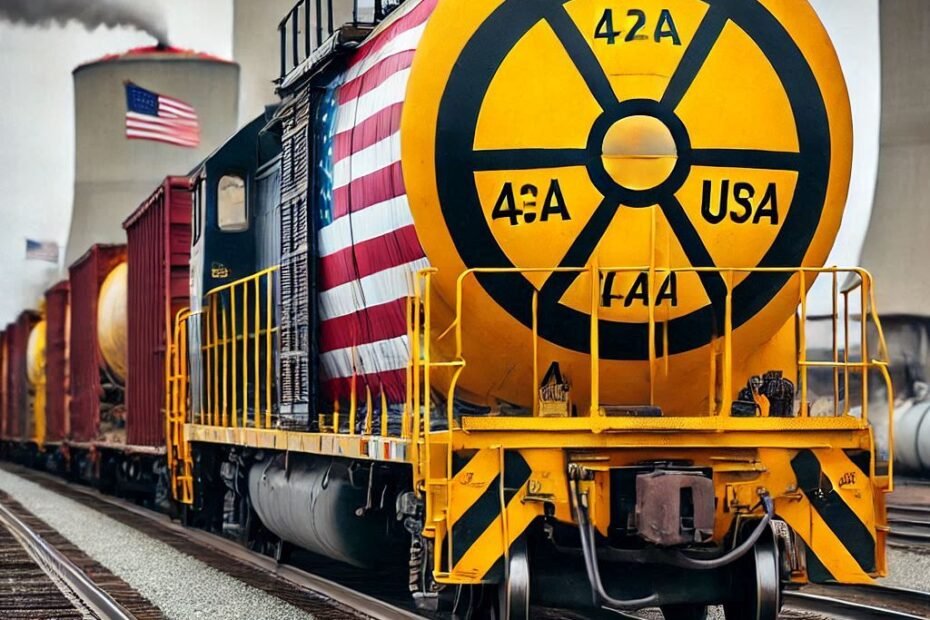
UF6 (uranium hexafluoride) rail transports in the USA can be considered a potential target for terrorist attacks for several reasons:
Radiological and Chemical Hazards
UF6 is a highly hazardous material due to its radiological and chemical properties. It is classified as a radioactive material (Class 7) and also has corrosive properties, which could lead to severe consequences if released or mishandled[1][4].
Criticality Risks
Transported UF6, especially if enriched above 5 weight percent U-235, poses a criticality risk. This means that if the cylinders were to be damaged or compromised in a way that allows the uranium to come into close proximity, it could potentially lead to a nuclear criticality accident, although such scenarios are highly regulated and protected against[4].
Potential for Widespread Impact
A successful terrorist attack on a UF6 transport could result in the release of radioactive material, which could affect extensive areas of land and cause long-term health consequences, such as increased cancer rates. The impact would depend on the scale and nature of the release[7].
Security Concerns Post-9/11
Following the September 11, 2001, terrorist attacks, there has been an increased focus on enhancing security measures for the transportation of hazardous materials, including UF6. However, nuclear facilities and transportations were not originally designed to withstand large-scale terrorist attacks, such as those involving aircraft or other significant sabotage[7].
Regulatory and Security Measures
While stringent regulations and security measures are in place to protect UF6 transports, including specific packaging requirements, thermal protectors, and multilateral approvals, the potential for a determined terrorist attack remains a concern. The Pipeline and Hazardous Materials Safety Administration (PHMSA) and other agencies have implemented enhanced security protocols to mitigate these risks, but the threat persists due to the high-consequence nature of the material[1][5][7].
In summary, the combination of radiological, chemical, and criticality hazards associated with UF6, along with the potential for widespread impact and the historical context of increased security concerns post-9/11, make UF6 rail transports a potential target for terrorist attacks.
Sources:
[1] [PDF] Transport of UF6 and the future of thermal compliance https://resources.inmm.org/system/files/patram_proceedings/2010/2_Paper_TransportOfUF6AndTheFutureOfThermalCompliance.pdf
[2] Uranium Hexafluoride Transport – Current Issues https://www.wise-uranium.org/etiss.html
[3] Terroranschläge in den Vereinigten Staaten von Amerika https://www.assemblee-nationale.fr/11/dossiers/attentats/attentats-3.asp
[4] Transportation Of New Fuels | NRC.gov https://www.nrc.gov/materials/new-fuels/transportation.html
[5] [PDF] SECURITY – Pipeline and Hazardous Materials Safety Administration https://www.phmsa.dot.gov/sites/phmsa.dot.gov/files/docs/Enhanced%20Security%20Brochure.pdf
[6] [PDF] Der Afghanistan-Einsatz 2001-2021 Eine sicherheitspolitische … https://www.bundestag.de/resource/blob/881198/27fd4f597e1d4ee43350aafffc6f%209d8c/WD-2-062-21-pdf-data.pdf
[7] [PDF] Assessing the risk of terrorist attacks on nuclear facilities https://www.parliament.uk/globalassets/documents/post/postpr222.pdf
[8] Information Notice No. 90-27: Clarification Of The Recent Revisions … https://www.nrc.gov/reading-rm/doc-collections/gen-comm/info-notices/1990/in90027.html
[9] [PDF] information gaps and potential information needs associated with … https://www.nrc.gov/docs/ML2102/ML21021A326.pdf
The uranium hexafluoride (UF6) supply chain itself, a critical component of the nuclear fuel cycle, is also facing significant risks in the United States.
These challenges pose substantial threats to the country’s nuclear energy sector and its ability to maintain a reliable and secure supply of nuclear fuel.
Dependence on Foreign Sources
One of the most critical vulnerabilities is the increasing reliance on foreign sources of uranium. The U.S. uranium conversion supply is heavily dependent on international markets, particularly due to the temporary suspension of UF6 production at the Honeywell Metropolis Works (MTW) in Illinois, the only uranium conversion plant in the USA. This suspension, which began in November 2017, was a result of significant challenges faced by the nuclear industry, including a global oversupply of UF6 and decreased demand following the Fukushima accident in 2011[3].
The reliance on foreign sources exacerbates the risk, as U.S. companies are often excluded from the domestic markets of foreign state-owned and state-subsidized competitors. These foreign entities can engage in predatory pricing and market manipulation, further depressing the market for U.S. producers[1].
Inventory Shortages and Supply Disruptions
The U.S. nuclear utilities currently hold sufficient inventories of uranium to support only about six months of UF6 production at MTW. In contrast, China has amassed inventories sufficient to fuel its current fleet of reactors for over 12 years. This disparity highlights the alarming rate at which the U.S. is becoming dependent on foreign sources of uranium. Any disruption to international trade would have a near-immediate impact on MTW’s ability to supply U.S. nuclear utilities[1].
Lack of Investment and Capacity in Conversion Facilities
The conversion sector is plagued by a lack of investment and capacity. The Euratom Supply Agency has identified the lack of investments in conversion facilities as the second most significant risk facing the entire nuclear fuel supply chain. The temporary suspension of production or shortage of capacity in conversion facilities is also a major concern, making conversion the only services sector of the supply chain identified twice as a significant risk[1].
Impact of Geopolitical Tensions
Geopolitical tensions and trade policies further complicate the UF6 supply chain. The „America First“ policy and potential import tariffs proposed by the Trump administration could significantly impact the global trade dynamics, including the nuclear fuel cycle. These measures could lead to increased costs and reduced availability of UF6, as companies might need to adapt their supply chains to avoid tariffs and other trade restrictions[4].
Workforce and Infrastructure Challenges
The logistics and transportation sector, crucial for the UF6 supply chain, is also facing challenges. A severe shortage of truck drivers in the U.S., estimated to be over 60,000 in 2023, and the need for fleet modernization to comply with stricter environmental regulations, add to the complexity and cost of maintaining a reliable supply chain[2].
Mitigation Strategies
To address these risks, several strategies are being considered:
1. DOE Uranium Reserve Program: The Department of Energy’s Uranium Reserve Program aims to provide uranium sufficient to support two years of U.S. reactor demand, which, although less than China’s reserves, is a significant improvement over the current limited U.S.-based supply[1].
2. Ensuring Domestic Participation: Priority should be given to ensuring that U.S. suppliers can participate in the supply chain, especially for high-assay uranium components. Any relaxations in trade agreements should be limited to enriched products in excess of 5% U235 to protect U.S. interests[1].
3. Investment in Conversion Facilities: Encouraging investment in conversion facilities and ensuring the full utilization of the sole U.S. conversion facility at MTW are crucial for reducing supply risks and enhancing the resilience of the UF6 supply chain[1].
In conclusion, the UF6 supply chain in the U.S. is fraught with significant risks, including dependence on foreign sources, inventory shortages, lack of investment in conversion facilities, and geopolitical tensions. Addressing these challenges through strategic investments, policy adjustments, and ensuring domestic participation is essential for maintaining a secure and reliable supply of nuclear fuel.
Sources:
[1] [PDF] January 14, 2022 – Regulations.gov https://downloads.regulations.gov/DOE-HQ-2021-0020-0076/attachment_1.pdf
[2] Sechs wichtige Trends und Herausforderungen für die Supply Chain https://www.efficioconsulting.com/de/publikationen/expertenmeinungen/sechs-wichtige-trends-und-herausforderungen-fuer-die-supply-chain/
[3] US conversion plant suspends UF6 production – World Nuclear News https://www.world-nuclear-news.org/Articles/US-conversion-plant-suspends-UF6-production
[4] Trumps Pläne und deren Auswirkungen auf die globalen Lieferketten https://www.bvl.de/blog/trump-und-die-supply-chains/
[5] HALEU Supply Chain: Transport Packages – Orano https://www.orano.group/usa/en/our-portfolio-expertise/orano-white-papers/haleu-supply-chain-transport-packages
[6] [PDF] Auswirkungen von Supply Chain Störungen auf den Aktienkurs https://digitalcollection.zhaw.ch/server/api/core/bitstreams/fda88b90-99b7-4638-8686-1661d5d57614/content
[7] [PDF] The Front End of the Nuclear Fuel Cycle: Current Issues https://crsreports.congress.gov/product/pdf/R/R45753
[8] (PDF) Untersuchung von aktuellen Trends und Herausforderungen … https://www.researchgate.net/publication/380036922_Untersuchung_von_aktuellen_Trends_und_Herausforderungen_im_Supply_Chain_Management_in_Deutschland