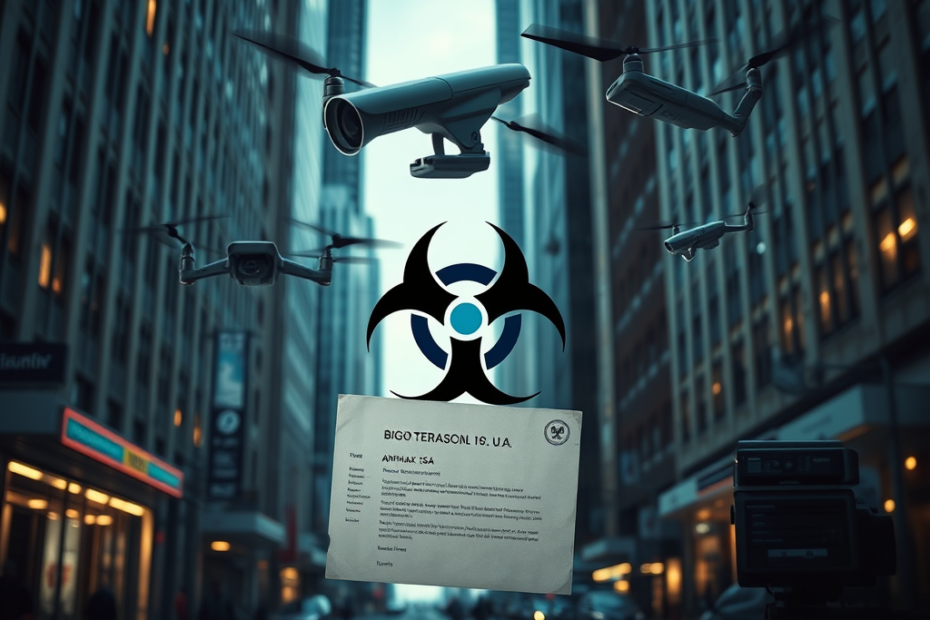
Bioterrorism, the deliberate release of biological agents to cause illness or death, poses a significant and ongoing threat to the United States. Here are some key studies, facts, and developments that highlight the gravity of this issue.
Historical Incidents and Threats
One of the most notable bioterrorist attacks in the U.S. occurred in October 2001, when four letters laced with anthrax were sent through the U.S. Postal Service, resulting in 22 illnesses and five deaths. This incident underscored the nation’s vulnerability to biological threats and led to significant legislative and regulatory changes, including the passage of the _USA PATRIOT Act_ and the _Public Health Security and Bioterrorism Preparedness and Response Act_ of 2002[9].
Frequency and Impact of Bioterrorist Attacks
Despite its relative rarity, bioterrorism has the potential to inflict mass injuries and casualties. Between 1970 and 2019, there were 33 recorded terrorist attacks involving biological agents, resulting in 9 deaths and 806 injuries. The majority of these incidents occurred in the United States, with anthrax being the most commonly used agent[7].
Current Threat Landscape
The threat of bioterrorism remains high due to several factors. Small quantities of lethal biological agents can be easily concealed, transported, and released into susceptible populations. The technologies for producing and weaponizing these agents are readily available, and only limited financing and training are needed to establish a biological weapons program[1].
In recent years, there has been an increase in aspirational and rudimentary interest in chemical and biological attacks among foreign and domestic threat actors. The Homeland Security Department’s 2025 Threat Assessment notes that there were 18 known deliberate chemical- or biological-related incidents in the U.S. over the last year, with some incidents linked to political or ideological motives[4].
Advanced Technologies and Emerging Threats
The exploitation of emerging technologies, such as DNA modification and artificial intelligence (AI), is a growing concern. Threat actors have expressed interest in using these technologies to develop novel biological agents that could target specific groups. Additionally, the advancement of unmanned aircraft systems (UAS) technology raises the potential for these systems to be used in chemical or biological attacks[4].
Detection and Response Efforts
To mitigate these threats, the U.S. Department of Homeland Security (DHS) has established the BioWatch Program, which provides early warning of bioterrorist attacks in over 30 major metropolitan areas. This program involves a network of stakeholders from public health, emergency management, law enforcement, and scientific organizations to detect and prepare a coordinated response to bioterrorism attacks. DHS is continuously upgrading biodetection technology to address a wide range of bioterrorism threats and improve real-time data sharing and information exchange between federal, state, and local operators[2].
Regulatory Measures
The Federal Select Agent Program has been strengthened over the years to regulate the possession, use, and transfer of select agents that pose a severe threat to public health and safety. Executive orders and legislative actions have enhanced laboratory biosecurity, tiered the select agent list, and established stringent physical and information security standards for high-risk agents[9].
In conclusion, the threat of bioterrorism in the U.S. is real and multifaceted, requiring continuous vigilance, advanced detection technologies, and robust regulatory measures to protect the public. As technologies evolve, so too must the strategies to counter these threats.
Sources:
[1] Combating the Threat of Biowarfare and Bioterrorism | BioScience https://academic.oup.com/bioscience/article/49/6/465/229529
[2] Detecting Bioterrorism – Homeland Security https://www.dhs.gov/archive/detecting-bioterrorism
[3] Original Pressetexte aus britischen und US-amerikanischen Medien https://www.bildungsserver.de/onlineressource.html?onlineressourcen_id=64245
[4] [PDF] Homeland Threat Assessment 2025 https://www.dhs.gov/sites/default/files/2024-10/24_0930_ia_24-320-ia-publication-2025-hta-final-30sep24-508.pdf
[5] Future Bioterror and Biowarfare Threats – Marine Corps University https://www.usmcu.edu/Outreach/Marine-Corps-University-Press/MCU-Journal/JAMS-vol-14-no-1/Future-Bioterror-and-Biowarfare-Threats/
[6] Religion – Harrassowitz Verlag https://www.harrassowitz-verlag.de/thema_827.ahtml
[7] Bioterrorism: An analysis of biological agents used in terrorist events https://pmc.ncbi.nlm.nih.gov/articles/PMC8818129/
[8] Anglistik. Amerikanistik – DBIS https://dbis.uni-regensburg.de/HMT/browse/subjects/5/
[9] History | Federal Select Agent Program https://www.selectagents.gov/overview/history.htm