Zum Inhalt springen

Delta Force Delivers: Maduro Snatched in Midnight Raid – „One Down, Xi Next?“

In a daring operation that would make even Hollywood blush, U.S. Delta Force commandos swooped into Caracas under cover of darkness, bagging Venezuelan strongman Nicolás Maduro and his wife Cilia like a late-night Amazon delivery gone rogue. President Trump, ever the showman, announced the coup de grâce on Truth Social: „Large scale strike SUCCESS! Maduro and the Missus captured and flown out. Narco-terrorist regime OVER. Great job, troops!“ Eyewitnesses in Caracas reported explosions lighting up the sky like New Year’s Eve on steroids, followed by the whir of Black Hawks extracting the bewildered dictator from his presidential palace. Maduro, reportedly still in his signature red tracksuit, was overheard muttering about „imperialist gringos stealing my arepas“ as he was zip-tied and bundled aboard. The White House justified the snatch-and-grab as „long-overdue justice“ for Maduro’s alleged role in flooding America with drugs… 
Trump’s Rubicon Crossing: The Illegal Kidnapping of Maduro Marks Him as Enemy Number One to Sovereign States

On January 3, 2026, the United States under President Donald Trump executed a daring and unprecedented military operation in Venezuela, culminating in the capture and forcible removal of President Nicolás Maduro and his wife, Cilia Flores, from their homeland. Trump announced the success of this „large-scale strike“ on his Truth Social platform shortly after 4:30 […] Trump’s Rubicon Crossing: The Illegal Kidnapping of Maduro Marks Him as Enemy Number One to Sovereign States

Trumps Angriff auf Venezuelas Souveränität:  katastrophale Auswirkungen auf die Gesundheitsversorgung der Bevölkerung

Die Administration von Donald Trump hat am 3. Januar 2026 einen massiven militärischen Schlag gegen Venezuela geführt, der in der Festnahme und Ausfliegung von Präsident Nicolás Maduro und seiner Frau gipfelte. Trump selbst verkündete auf Truth Social, dass die USA einen „großangelegten Schlag“ gegen Venezuela durchgeführt hätten, in dessen Verlauf Maduro gefasst und aus dem… Trumps Angriff auf Venezuelas Souveränität:  katastrophale Auswirkungen auf die Gesundheitsversorgung der Bevölkerung

Trump’s Assault on Venezuela: Devastating Consequences for the Population’s Healthcare Amid Western Hypocrisy

Donald Trump’s administration has initiated aggressive military operations against Venezuela, exacerbating an already catastrophic healthcare crisis in the country. Since September 2025, U.S. forces have conducted at least 21 strikes on vessels in the Caribbean and Pacific, killing over 83 people under the pretext of combating drug trafficking. These actions escalated dramatically by late December 2025 with a CIA drone strike on a coastal facility, followed by explosions in Caracas on January 3, 2026, targeting military sites like Fuerte Tiuna, La Carlota airbase, and a communications center in El Hatillo. Witnesses reported at least seven blasts, power outages across southern districts, and U.S. helicopters overhead. The U.S. has deployed thousands of troops and naval assets in the Caribbean, the largest presence since 1989, including aircraft carriers and destroyers under Operation Southern Spear. Venezuela, with a population of about 26.7 million,… 

FAIR-Grundlagen für ein neuartiges Indikatoren-Repository zu nichtübertragbaren Krankheiten in der Europäischen Union

Eine Machbarkeitsstudie hat die Möglichkeiten zur Verbesserung der Nutzbarkeit und Transparenz von Indikatoren für nichtübertragbare Krankheiten in der Europäischen Union untersucht. Durch die Kontextualisierung von Indikatoren soll die Vergleichbarkeit über nationale Grenzen hinweg gesteigert werden. Die Forscher haben ein Metadatenmodell angepasst, das FAIR-Prinzipien nutzt, um Daten findbar, zugänglich, interoperabel und wiederverwendbar zu machen. Als Proof-of-Concept wurde das Modell auf Diabetes-Indikatoren angewendet und auf alle nichtübertragbaren Krankheiten erweitert. Die Studie endet mit sieben Empfehlungen für die Umsetzung auf EU-Ebene, die eine bessere Integration heterogener Datenquellen ermöglichen sollen. Hintergrund zu Indikatoren und nichtübertragbaren Krankheiten in der EU Nichtübertragbare Krankheiten wie Diabetes, Herz-Kreislauf-Erkrankungen oder Krebs verursachen jährlich Millionen Tote in der Europäischen Union und belasten die Gesundheitssysteme erheblich. Die Vergleichbarkeit von Gesundheitsindikatoren zwischen Ländern ist entscheidend für Benchmarking, Politikgestaltung und Ressourcenverteilung. Allerdings erschweren heterogene Datenquellen und fehlende Kontextinformationen diese Vergleiche. Indikatoren entstehen durch… 

Machine Learning Model Validates Vibroacoustic Sensor Array for Fetal Movement Monitoring

A new machine learning framework has been developed to detect fetal movements using a wearable array of vibroacoustic sensors, offering a potential tool for assessing fetal health during pregnancy. The system combines piezoelectric and acoustic sensors to capture a range of movements, validated against ultrasound as the gold standard. An ensemble model achieved moderate precision and recall in identifying movements, demonstrating feasibility for low-cost monitoring, especially in resource-limited settings where stillbirth rates remain high. Background on Stillbirth and Fetal Movement Monitoring Stillbirth represents a significant global health challenge, with estimates indicating around two million cases annually, disproportionately affecting low- and middle-income countries. Regional disparities are stark, with rates exceeding 20 per 1,000 births in parts of Africa compared to under three in Western Europe. Underreporting in these areas exacerbates the issue, underscoring inequalities in healthcare access. Factors like maternal education,… 

Deep Multimodal AI Framework Predicts Domain-Specific Cognitive Decline in Alzheimer’s Disease

Researchers have developed an advanced artificial intelligence system capable of forecasting cognitive decline in specific domains for individuals on the Alzheimer’s spectrum. By integrating multiple neuroimaging modalities with deep learning techniques, the approach achieves notable accuracy in predicting trajectories across memory, language, executive function, and visuospatial abilities. This innovation addresses a critical gap in Alzheimer’s management, where traditional methods often focus on broad diagnostic shifts rather than detailed cognitive patterns. Background on Alzheimer’s Disease and Cognitive Decline Alzheimer’s disease stands as the leading cause of dementia globally, affecting millions and imposing substantial burdens on healthcare systems. It typically begins with mild memory issues that progress to broader impairments, eventually leading to severe functional limitations. However, the rate and pattern of this progression vary widely among individuals, influenced by genetics, lifestyle, environmental factors, and co-existing conditions. This variability complicates early intervention… 

Latest AI and Tech News Highlights – January 2, 2026

As we enter 2026, artificial intelligence is advancing rapidly in robotics, medicine, and software tools—while simultaneously facing serious ethical challenges. Here are the key developments dominating discussions today. Stanford Unveils Dream2Flow: Robots Can Now “Imagine” Tasks Before Performing Them A research team at Stanford University has introduced Dream2Flow, an innovative framework designed to narrow the longstanding divide between video-generation AI and physical robotics. The system allows robots to generate imagined video sequences of a task, then extract precise 3D movement trajectories for objects involved. This enables more adaptable and reliable manipulation in real-world, unstructured settings—from handling rigid items like cups to deformable objects like loaves of bread. The approach tackles the “embodiment gap,” where AI models excel at simulating visuals but lack understanding of physical forces such as friction, torque, and robotic joint constraints. AI-Assisted Mammography Saves Lives Through Earlier… 

Germany’s Missed Opportunity in Developing Native LLM Software

Germany, despite its strong engineering tradition and significant investments in research, has failed to produce competitive, independently developed large language model (LLM) software stacks comparable to those emerging from the United States and China. This gap is evident in the absence of German-origin foundation models that dominate global leaderboards, Hugging Face downloads, or production deployments. While efforts like Aleph Alpha’s Luminous series and government-backed projects such as OpenGPT-X exist, they remain proprietary or limited in scale, lacking the open-source momentum, architectural innovations, and ecosystem integration seen elsewhere. For IT specialists, this manifests concretely in the inability to point to German-authored training pipelines, novel transformer variants, or inference optimizations that underpin frontier LLMs. At the core of LLM development is the software stack: frameworks for model definition, distributed training, and efficient inference. The dominant frameworks are PyTorch (Meta, US), TensorFlow (Google,… 

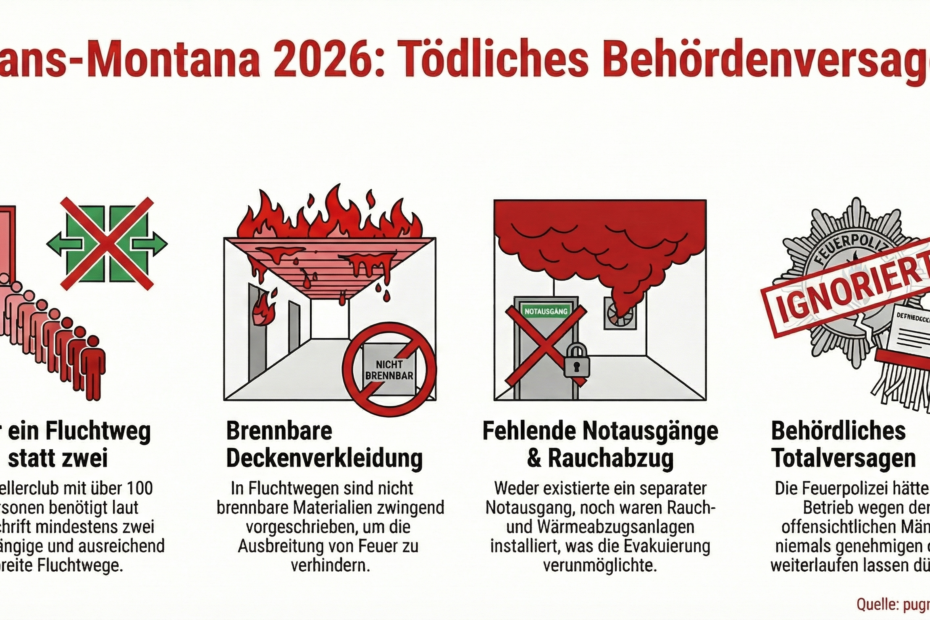
Crans-Montana: Tödliches Behördenversagen

Die Brandkatastrophe in der Bar Le Constellation in Crans-Montana am 1. Januar 2026 forderte rund 40 Tote und über 100 Verletzte. Das Feuer brach in einem Untergeschossraum aus, der als Nachtclub genutzt wurde und eine hohe Personenbelegung aufwies. Der einzige Fluchtweg führte über eine enge Treppe nach oben, ohne separaten Notausgang. Dies führte zu einer… Crans-Montana: Tödliches Behördenversagen