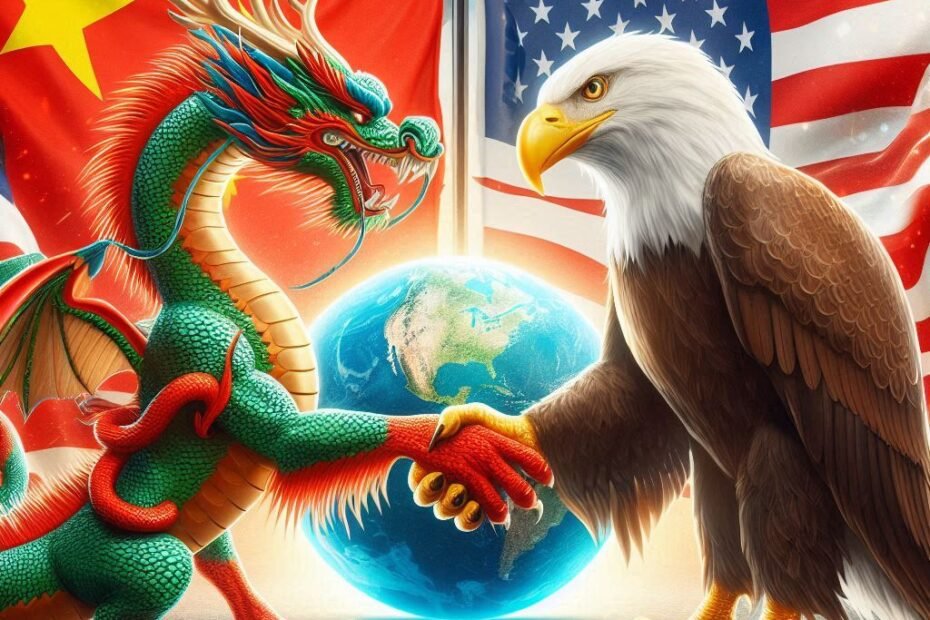
The collaboration between the United States and China in the life sciences has been a significant driver of scientific progress over the past few decades. However, recent geopolitical tensions and policy changes have begun to impact this crucial partnership.
Historical Context
The U.S.-China Science and Technology Agreement (STA), first signed in 1979, laid the foundation for scientific cooperation between the two nations[4]. Initially focused on agricultural research, the agreement expanded over time to encompass a broader range of scientific fields, including the life sciences. This collaboration has been instrumental in fostering groundbreaking research and innovations in areas such as agriculture, clean energy, public health, and the environment[2]
Collaboration Trends
For many years, China has been the United States‘ most important collaborator in the life sciences. Since 2013, China has held this top position[1]. The partnership has led to a rapid increase in both the quantity and quality of joint papers by Chinese and U.S. researchers[2].
However, recent data shows a concerning trend. U.S.-China collaborations in life sciences appear to have slowed down starting in 2019, coinciding with the initiation of investigations by the National Institutes of Health (NIH)[1]. This decline has become more pronounced in subsequent years.
Impact on Scientific Output
A study published in the Proceedings of the National Academy of Sciences examined the impact of NIH-initiated investigations on U.S. scientists‘ productivity. The research analyzed over 113,000 scientists and found that these investigations coincided with reduced productivity for those collaborating with Chinese peers compared to those working with other international collaborators[1].
The decline in productivity was particularly notable in fields that received greater pre-investigation NIH funding and had more extensive U.S.-China collaborations[1]. This suggests that the impact of these policy changes may be most severe in areas where collaboration was previously strongest.
Biotech Industry Implications
The biotech industry provides a stark example of the potential consequences of reduced collaboration. Many achievements under the STA, such as U.S.-China collaborations on gene editing research that have created disease-resistant crops and improved yields, are at risk of being diminished[2].
Patrick Beyrer, a researcher at the Asia Society Policy Institute’s Center for China Analysis, has warned that a potential U.S.-China biotech decoupling could have significant consequences. He notes that China is the largest and most cost-effective exporter of active pharmaceutical ingredients to the U.S. market, and that jointly developed drugs and agricultural technologies have improved countless American lives[2].
Global Scientific Leadership
Despite the challenges, China has been making significant strides in scientific output. In 2022, for the first time, China overtook the United States as the top-ranked country for contributions to research articles published in the Nature Index group of high-quality natural-science journals[5]. While this metric doesn’t specifically focus on life sciences, it indicates China’s growing scientific capabilities.
In the life sciences specifically, China is still trailing the U.S., but the gap is narrowing. China’s Share (a metric that accounts for the percentage of authors from a nation on each paper) in life sciences has been rapidly increasing[5].
Concerns and Future Outlook
The decline in U.S.-China scientific collaboration raises concerns about the future of global scientific progress, particularly in addressing grand challenges such as climate change, pandemics, and food security[6]. Many scientists argue that reviving U.S.-China collaborations is crucial for bridging gaps and advancing scientific knowledge[6].
Roger Pielke Jr, a nonresident senior fellow at the American Enterprise Institute, has expressed support for continuing the STA „in the most robust form that can be negotiated between the two nations“[2]. He argues that the very existence of such an agreement is more important than its specific details and views „decoupling“ as detrimental to science and technology[2].
As the scientific community grapples with these challenges, the future of U.S.-China collaboration in the life sciences remains uncertain. The outcome will likely have significant implications for global scientific progress and the ability to address pressing global challenges.
Sources:
[1] The impact of US–China tensions on US science – NCBI https://www.ncbi.nlm.nih.gov/pmc/articles/PMC11087765/
[2] Experts call for US-China science cooperation to overcome hurdles https://global.chinadaily.com.cn/a/202409/12/WS66e2280da3103711928a77d1.html
[3] [PDF] Growing U.S. Reliance on China’s Biotech and Pharmaceutical … https://www.uscc.gov/sites/default/files/2019-11/Chapter%203%20Section%203%20-%20Growing%20U.S.%20Reliance%20on%20China%E2%80%99s%20Biotech%20and%20Pharmaceutical%20Products.pdf
[4] What Future for U.S.-China Science and Technology Collaboration? https://www.aei.org/articles/what-future-for-u-s-china-science-and-technology-collaboration/
[5] China overtakes United States on contribution to research in Nature … https://www.nature.com/articles/d41586-023-01705-7
[6] China–US research collaborations are in decline — this is bad news … https://www.nature.com/articles/d41586-024-02046-9
[7] US–China science collaboration to solve global grand challenges https://www.pnas.org/doi/10.1073/pnas.2320207120