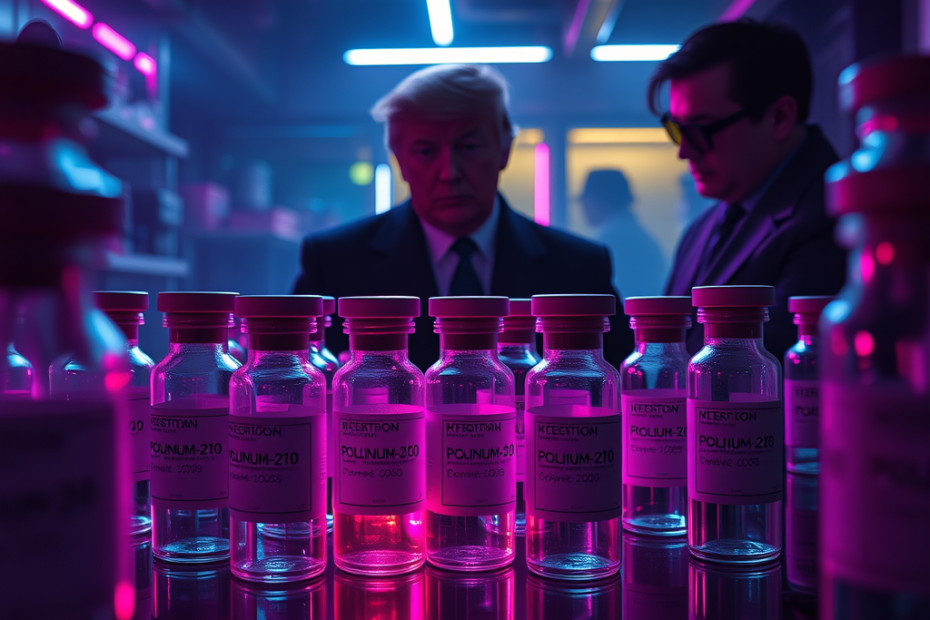
The Most Potent and Elusive Poisons Used by Intelligence Agencies could become a growing risk for Donald Trump and Elon Musk. LabNews has the details.
In the realm of espionage, the use of highly potent and difficult-to-detect poisons has been a recurring tactic to eliminate adversaries. Here, we will examine some of the most notorious substances employed by intelligence agencies and discuss why even public figures, such as U.S. President-Elect Donald Trump, could potentially be at risk.
Polonium-210
Polonium-210 stands out as one of the most deadly and elusive poisons. This radioactive element, derived from uranium ore, was infamously used to poison former Russian FSB agent Alexander Litvinenko in 2006. Polonium-210 is tasteless, odorless, and dissolves in water, making it an ideal candidate for covert poisoning. Its lethal dose is as small as a few milligrams, and it can cause severe damage by breaking apart oxygen molecules to create highly reactive free radicals that damage DNA and kill cells[3][7].
The detection of Polonium-210 is highly challenging, especially if the investigation begins too late. However, in Litvinenko’s case, the unique energy signature of the alpha particles emitted by Polonium-210 (around 5.3 mega-electronvolts) helped doctors identify the poison[3].
Novichok Agents
Developed by the Soviet Union in the 1970s and 1980s, Novichok agents are a class of fourth-generation chemical weapons designed to be undetectable by standard NATO chemical detection equipment and to circumvent the Chemical Weapons Convention. These binary nerve agents are formed by mixing precursors just prior to use, making them safer to handle and transport but extremely potent once activated. Novichok agents, such as A-234, are estimated to be five to eight times more potent than VX, with a median lethal dose for inhaled A-234 being as low as 7 mg/m³ for a two-minute exposure[5].
The use of Novichok agents was highlighted in the 2018 poisoning of former Russian double agent Sergei Skripal and his daughter in Salisbury, UK. These agents can be disguised as pesticide precursors, adding to their stealth and lethality.
Nerve Agents (e.g., Organophosphates)
Organophosphates, a broad group of chemicals that include nerve agents, are highly toxic and can be lethal in small doses. These agents can be effectively disguised in drinks and require sophisticated tests for detection, which many hospital labs lack. For instance, the nerve agent used in the poisoning of Russian opposition leader Alexei Navalny is believed to be from the Novichok family or a similar highly toxic organophosphate. These agents can cause rapid neurological deterioration and death if not promptly treated[1].
Why Public Figures Like Donald Trump and Elon Musk Could Be at Risk
Public figures, including President-Elect Donald Trump, are inherently at risk due to their high profiles and the ease with which these poisons can be administered.
1. Accessibility and Stealth: Poisons like Polonium-210 and Novichok agents are designed to be undetectable and can be administered in various forms, such as in food or drinks, making them particularly dangerous for public figures who often have less control over their immediate environment.
2. Lack of Immediate Detection: The sophisticated tests required to identify these poisons mean that initial medical responses may not detect the true cause of symptoms promptly. This delay can be fatal, as seen in the cases of Litvinenko and Skripal[3][5].
3. Public Exposure: Public figures frequently interact with a wide range of people, increasing the potential for an assassin to get close enough to administer a poison. Even seemingly secure environments can be breached, as evidenced by the Skripal poisoning in a public place.
4. Medical Vulnerability: The suggestion by former President Trump to use unproven and dangerous medical treatments, such as injecting disinfectant, highlights a broader issue of medical vulnerability. If such advice were followed, it could exacerbate health risks and potentially create an environment where more sinister poisoning attempts might go undetected or misdiagnosed[2].
In conclusion, the use of highly potent and elusive poisons by intelligence agencies poses a significant threat to public figures and others who may be targeted. The stealth, lethality, and difficulty in detection of these substances underscore the need for heightened security measures and advanced medical capabilities to counter such threats.
Sources:
[1] Navalny and Russia’s arsenal of exotic poisons – BBC https://www.bbc.com/news/world-europe-53907761
[2] Outcry after Trump suggests injecting disinfectant as treatment – BBC https://www.bbc.com/news/world-us-canada-52407177
[3] 6 Deadly ‚Undetectable‘ Poisons (and How to Detect Them!) https://nerdfighteria.info/v/oqqWdaaTq7A/
[4] FDA warns of heart risks with Trump-promoted malaria drug – PBS https://www.pbs.org/newshour/science/fda-warns-of-heart-risks-with-trump-promoted-malaria-drug
[5] Novichok – Wikipedia https://en.wikipedia.org/wiki/Novichok
[6] TRUMP ADMINISTRATION MARKS NATIONAL LEAD POISONING … https://archives.hud.gov/news/2018/pr18-125.cfm
[7] Top 5 deadly poisons – DW – 03/09/2018 https://www.dw.com/en/spy-assassinations-the-top-5-deadly-poisons/a-42909685
[8] faq https://www.google.de/policies/faq